Everyone remembers the night the sidewalk cracked, but nobody agrees on when it really happened.
Officially, it was after the fire trucks left. After the hoses lay coiled on the curb like shed skins. After the building on the corner stopped screaming and settled into that embarrassed quiet places get when they’ve shown too much of themselves in public.
That’s the version that makes it into reports. The kind you can file away.
Me? I think it started long before that. I think the crack was just the first time the block stopped pretending.
I wasn’t there for the fire.
I got back the morning after, when the neighborhood was already back in performance mode. People sweeping glass they didn’t break. Folks shaking their heads and saying damn like the word itself counted as mourning. The air still smelled like wet ash and burned wiring, sharp enough to scrape the inside of your nose.
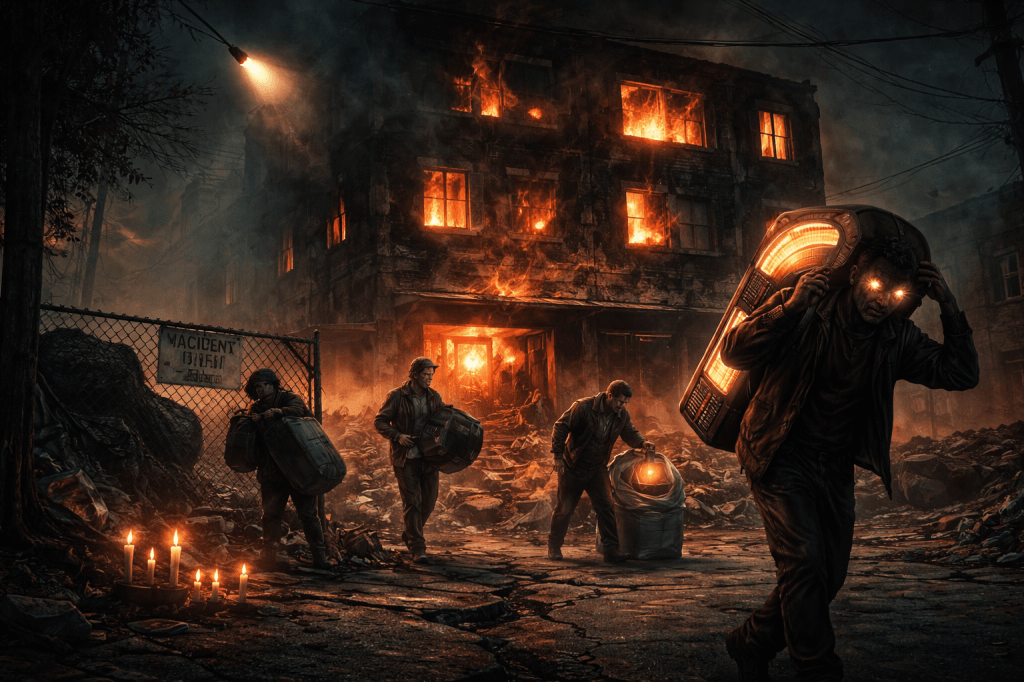
The building looked ashamed. Blackened brick, windows blown out, its mouth frozen open mid-cry. Someone had already zip-tied a handwritten sign to the chain-link fence: ACCIDENT. NO FOUL PLAY.
That sign always shows up fast. Like the block’s immune response.
The concrete beneath it had split clean down the middle.
No sinkhole. No blast scar. Just a long, deliberate fracture running from the curb straight to the foundation, like the ground had finally decided to say something it’d been holding in.
People stepped around it.
They always do.
I was there for my brother.
Rafael didn’t die in the fire. That’s what made it worse. They found him three blocks away, laid out behind a shuttered laundromat, lungs clean, skin cold, eyes wide like he’d seen something that finished him before the smoke ever could. No soot. No burns. Just that look—like the last thing he understood came too late to matter.
The report said cardiac arrest.
The block didn’t say shit.
I stayed longer than I meant to. You always do when you’re waiting for a place to confess. I slept on my aunt’s couch and listened to the building creak at night, the sound low and wet, like something adjusting its grip.
That’s when the patterns started showing themselves.
Cracks that hadn’t been there the day before. Brick dust collecting in corners where no brick had fallen. A vibration underfoot that felt like distant traffic that never arrived. At night, the sidewalk warmed—not heat, exactly. Memory. Like the ground was replaying old pressure just to feel it again.
I learned quick that the block wasn’t hungry.
That’s what people get wrong. Hunger implies need. Weakness. Something you can feed or outrun.
The block didn’t need anything.
It was full.
Full of grief with nowhere to go. Full of violence that never got to finish explaining itself. Full of certainty—the worst kind. The kind that makes people step heavy because they think they’ve earned safety.
Rafael had grown up here. Learned the shortcuts. Learned which sirens meant nothing and which meant run. He thought knowing the rhythm made him immune.
It doesn’t work like that.
The first night I heard the breathing, I was standing at the fracture line, saying my brother’s name out loud like volume could force an answer. The sound didn’t echo. It sank. Straight down.
The breathing didn’t come from below.
It came from everywhere.
Slow. Patient. Like something waiting to see if I’d flinch.
I didn’t.
That’s important. I didn’t panic. Didn’t pray. Didn’t pretend it was just pipes or rats or the city settling. I stood there and listened.
And whatever it was… withdrew.
That’s the rule, I’d learn later. Fear feeds the scavengers. Refusal starves them. The block softens you first. Others come after.
I started asking questions after that.
Quiet ones.
Turns out I wasn’t the only one who’d noticed strange traffic the night of the fire. Not firefighters. Not cops. People coming out of the basement while everyone else was running away.
Addicts, mostly. Faces I recognized from the corners. From the stoops. From that half-visible layer of the neighborhood everyone swears they don’t see.
They were carrying things.
Not scrap. Not copper. Whole objects. Lamps. Chairs. A microwave with the cord still wrapped neat. One man staggered out with a jukebox on his back—brand new, chrome sides still wrapped in plastic like it had been waiting for someone.
He shouldn’t have been able to carry it alone.
People laughed about it later. Said it was crackhead strength. Said desperation does wild things to the human body.
But I saw his face.
Or what passed for one.
His eyes were gone. Not burned out. Missing. Each socket filled with something dark and distant, tiny points of light scattered inside like star constellations that didn’t belong to this sky. He smiled like the jukebox was whispering directly into his bones.
That thing wasn’t stolen.
It was claimed.
Someone else mentioned seeing Princess that night. Same Princess from down on Polk Street. The one who always smelled like old perfume and pennies. She’d been circling the building before the fire, slipping in and out of doorways like she was checking inventory. Nobody ever caught her stealing, exactly. She just… moved where she wasn’t supposed to be, like the block had already cleared her.
Princess always survives. That’s not luck. That’s alignment.
The fire itself felt almost secondary. Like a distraction. Like something loud meant to draw eyes upward while the real work happened below.
That’s when I understood something else: the concrete doesn’t keep everything for itself.
It cooperates.
There are others that move the softened edges. Things that slip in after fear loosens the seams. Not rivals. Not predators fighting over territory.
Scavengers.
I never heard her name growing up, not directly. Just descriptions. Warnings disguised as jokes. Don’t follow voices you recognize when nobody’s there. Don’t answer someone calling you from behind when you know you’re alone. Don’t trust a face that feels borrowed.
Some nights, walking home, I’d hear laughter that sounded skinned. Too wet. Too close to the throat. Like someone wearing joy instead of feeling it. Sometimes it borrowed my mother’s voice. Sometimes Rafael’s.
Children notice her first. Always have. Kids don’t rationalize. They feel the wrongness and name it monster and keep it moving. Adults explain it away. Stress. Trauma. Pipes. Wind through broken windows. Adulthood teaches you how to ignore survival instincts in favor of rent and routine.
She feeds on fear already tenderized by the block. She doesn’t hunt. She harvests.
I caught a glimpse once, reflected in a bodega window after midnight. A woman-shaped absence leaning where my reflection should’ve been. Her skin looked like it had been peeled by laughter. Her mouth moved without sound, breathing fogging glass that wasn’t there.
I didn’t react.
She tilted her head. Curious. Then she was gone.
That’s another rule: if you don’t give her fear, she doesn’t take anything else.
The night the crack widened, the block felt restless. The fracture pulsed under my feet, opening just enough to remind me it could. I thought about Rafael. About how far fear can carry someone before something finishes the job.
I thought about the jukebox.
About how music has always been a mouth.
I left before dawn. Packed light. Didn’t look back.
People say that’s why I’m still alive.
They’re wrong.
The block didn’t keep me.
Not yet.
But sometimes, late at night, I hear breathing through my floorboards. Slow. Patient. Waiting to see if I remember how to be afraid.
I don’t.
And somewhere, beneath cracked sidewalks and borrowed faces, the concrete listens.
Tags: Urban Horror, Original Fiction, The Block That Never Sleeps
Internal Links:
 The Story Monster
Leave a comment