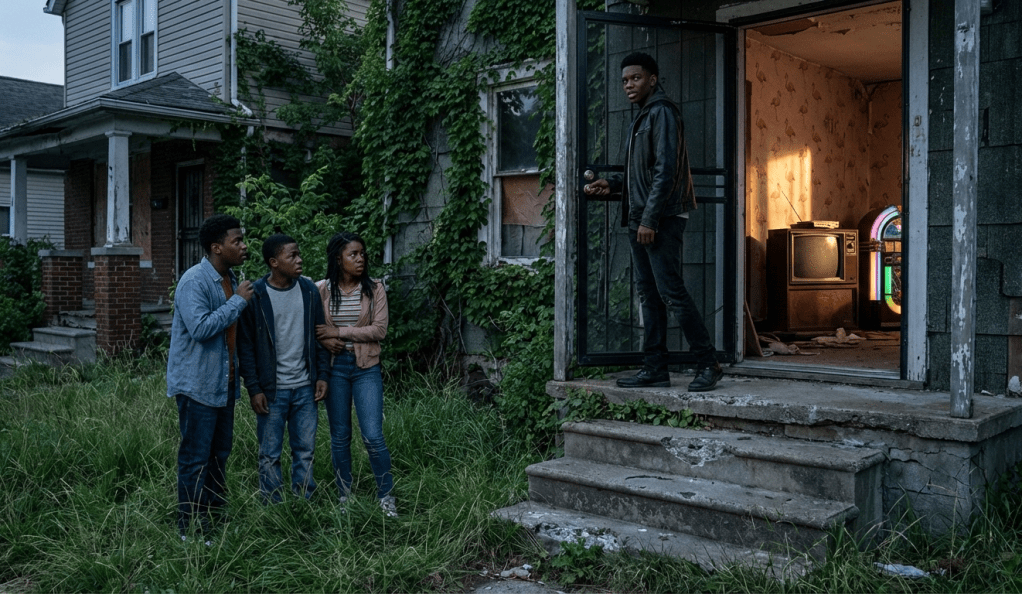
People like to cast me in a certain light. They see the height, the way I carry my shoulders like I’m looking for a reason to drop them, and they think they’ve seen the movie before. I’m the “bad boy” in the leather jacket, the one smoking in slow motion while the soundtrack gets heavy. Being the biggest sophomore at Crenshaw didn’t help the image, and neither did the knuckles I was constantly icing after school.
But most of the time, I wasn’t some cinematic outlaw. I was just another kid wandering the concrete with a bunch of idiots. Cole, Bobby, and Princess—we were a four-headed beast of boredom, our bellies churning with cheap malt liquor and nothing but time to kill. We’d spend hours arguing over professional wrestling finishers or talking about the pranks we’d pulled on the teachers who had already given up on us.
Somehow, the heat and the liquor steered us toward the Dunlap House. It sat there like a rotting tooth in the middle of the neighborhood, abandoned since the 70s and ignored by everyone who knew better. The legends were baked into the sidewalk around it. Everyone had a version of the story where the lady who lived there butchered her kids and tucked them away in the deep freezer like Sunday leftovers.
“I heard the father was the one who went crazy,” Princess said, her voice dropping as we hit the edge of the overgrown lawn. “The mom was just the one who found them.”
Bobby shook his head, looking at the sagging porch. “Nah, the dad found ’em and called the cops. My cousin said the mom didn’t even know they were dead. She thought they were playing hide and seek.”
“They say she did it because the jukebox told her to,” Cole chimed in. He sounded like he actually believed it.
I let out a snort, trying to keep the buzz from turning into a shiver. “That makes no sense, man. Jukeboxes play records. They don’t give orders.”
“My mom told me when the precinct kicked in the door, they found her dancing,” Bobby added, ignoring me. “Just twirling around the living room, covered in old blood, humming a tune that wasn’t even playing.”
“Whatever,” I said, adjusting the weight of my jacket. “It’s just a house. Let’s check it out.”
They looked at me like I’d just rubbed apple sauce all over my face—confused, disgusted, and a little bit worried.
“Come on,” I mocked, leaning into the persona. “You really believe in ghosts? What a bunch of crap.”
I waited for one of them to step up, to show a little spine so I wouldn’t have to be the only one. But Cole just grabbed Princess’s hand like he was holding onto a life raft. “I don’t know, man. The roof looks like it’s ready to cave. It’s a death trap.”
“I got asthma,” Bobby muttered, staring at his sneakers. “The dust in there… it’ll mess with my lungs.”
I looked at their doe-eyed faces, seeing the reflection of the “bad boy” they expected me to be. I’d spent too long building that reputation to let it slide over a creepy porch.
“What a bunch of pussies,” I muttered.
I pushed through the vine-covered gate. The unkempt grass was thick and dry, slapping against the thighs of my jeans like reaching hands. The concrete steps were cracked and surrendered to the weeds, leading up to a black storm door that looked like it belonged on a vault. The paint was chipping away in long, gray scabs, and I noticed strange symbols carved into the wood—jagged, angry marks that didn’t look like any gang sign I knew.
I took a breath, shouldered the weight of the structure, and pushed.
The door swung back with a heavy, reluctant groan. A sliver of afternoon sunlight fought its way inside, illuminating a grimy floor thick with decades of filth. To my right, the windows were boarded up with decayed wood, sealing the place in a permanent twilight. An old floor-model television sat in the corner like a hollowed-out skull. The wallpaper was a nightmare of tacky, half-torn pink flamingos, all of them standing on one leg as if waiting for a flood.
The air in the dining room ahead was thick enough to chew. It smelled like dirty mop water and sweaty ass, a humid rot that made me pull my forearm over my nose. In the center of the room, an old fish tank stood on a rusted metal frame, filled with a mysterious, bubbling green liquid that looked like it had its own heartbeat.
Then, out of the corner of my eye, the darkness exploded.
Glows of neon—green, blue, red, yellow, orange, and purple—blinded me for a second. I stumbled back, my heart hammering against my ribs. I hadn’t seen it when I walked in. On the left side of the living room sat a digital music jukebox, its wooden finish gleaming like it had just been polished.
There was no way the power was on. This whole block was a graveyard of dead lines. But the tube lights were flashing in a frantic, hypnotic pattern. Inside the glass, a spring-loaded aluminum claw rose with a mechanical whine. It was smooth, precise, and terrifyingly alive. It lifted a CD and clicked it into place with a sickeningly clean thud.
The small LED screen flickered to life. Digital letters formed: Tears in Heaven – Eric Clapton.
The music started. But the voice wasn’t right. It was deep, garbled, and heavy, sounding like the singer was trying to perform while drowning in a pool of oil.
The front door didn’t just close—it slammed. The sound echoed through the house like a gunshot, cutting off the sunlight and locking me in with that distorted melody.
Before I could even scream, the jukebox began to move. It hissed as it slid across the floor in a half-circle, the heavy wood grinding against the boards. As it swung away from the wall, it revealed a gaping, black maw of a hidden entrance.
Then the voice came. It wasn’t the music. It was a shrill, jagged sound that pierced my ears from the shadows of that new hole.
“Oh,” it rasped, wet and hungry. “How I miss my children.”
The voice didn’t sound like a ghost. Ghosts were supposed to be wispy, like the wind through a cracked window. This voice was sharp, jagged, and wet. It sounded like a throat full of pennies and phlegm.
I froze. My heart wasn’t just beating; it was slamming against my ribs like a prisoner trying to kick down a cell door. I looked back at the front door, the one that had just slammed shut. The sunlight was gone. No more sliver of gold on the grimy floorboards. Just me, the smell of ancient rot, and that damn Eric Clapton song bubbling out of the jukebox like it was being played through a layer of grease.
“Who’s there?” I called out. My voice sounded small. Not the voice of the biggest sophomore at Crenshaw High. Not the voice of a guy who had handled himself in three different brawls behind the gymnasium this year. It was the voice of a kid who wanted his mother.
The hidden entrance behind the jukebox was a maw of pure black. The wood of the floor groaned as the machine finished its mechanical pivot. It settled with a heavy thud, the neon lights flickering once, twice, before settling into a sickly, rhythmic pulse of violet and red.
“I said, who is that?” I gripped the collar of my leather jacket. I felt like the leather was the only thing keeping me from shaking apart.
“So big,” the voice rasped from the dark. It was closer now. Just past the edge of the dining room where the fish tank sat. The green liquid inside the tank began to bubble, a slow, lazy hiss of gas escaping the slime. “A big, strong boy. My boys were never that big. They were little. Small enough to fit in the quiet places.”
I backed away, my sneakers squeaking on the linoleum. I hit the wall, my shoulder blades digging into the torn flamingo wallpaper. The paper felt damp, like skin. I looked toward the dining room, my eyes finally adjusting to the gloom.
A shape moved.
It wasn’t a shadow. It was a person, or something that used to be a person. She crawled—not on all fours like a dog, but with a strange, hitching motion, dragging her lower half like it didn’t quite belong to her. She wore a floral dress that might have been yellow once, but was now the color of a bruised banana, stained with dark, crusty patches. Her hair was a matted gray crown, tangled with bits of insulation and what looked like dried chicken bones.
She stopped at the edge of the light thrown by the jukebox. Her face was a map of deep, weeping wrinkles, and her eyes… they weren’t doe-eyed like Bobby and Cole out on the porch. They were milky, clouded over with cataracts, yet they seemed to lock right onto my throat.
“You’re the one,” she whispered. The jukebox transitioned; the motor whirred, and the claw swapped the CD. A new track started. Mr. Wendal by Arrested Development. But just like the Clapton song, it was pitched down, slow and distorted, the upbeat rhythm turned into a funeral march.
“I ain’t nobody,” I said, trying to find my swagger, trying to find that ‘bad boy’ persona I wore like armor every day. “I was just leaving. My boys are outside. They’re coming in here any second. You better let me out.”
The woman let out a sound—a wet, rattling giggle that ended in a cough. “The boys outside? They’ve already forgotten you, sugar. The house makes people forget. Once the door shuts, you’re just a memory that hasn’t faded yet.”
She reached out a hand. Her fingernails were long, yellow, and curved like talons. “Come see. Come see where they sleep. They’ve been so lonely. They need a big brother to tell them stories.”
She gestured toward the hidden opening behind the jukebox. A staircase led down. Not into a basement, but into something that felt deeper, a cellar that breathed.
I looked at the front door. I could try to kick it open, but the symbols I’d seen on the outside—the carvings on the storm door—they felt like they were pressing against the wood from the other side. I felt trapped in a ribcage.
“I’m not going down there,” I snapped. I reached into my pocket and pulled out my brass Zippo. I flicked it open. The flame was tiny, a flickering orange thumb in the oppressive dark. “Get back, lady. I’ll burn this whole dump down. I swear on my life.”
The woman didn’t flinch. She just kept that milky gaze on me. “Fire is just light, boy. And light doesn’t last here. Only the music lasts.”
She lunged.
For someone who looked like she was falling apart, she moved with a terrifying, jerky speed. I scrambled to the side, my boot catching on the edge of the floor-model TV. I tumbled, the Zippo flying from my hand and skittering across the floor. It didn’t go out. It landed near the fish tank, illuminating the base of the hidden passage.
I saw them then.
In the glow of the lighter, I saw the “children.” They weren’t in the freezer. Or maybe they had been, once. Now they were part of the house. Three of them, small and pale, their skin the color of parsnips. They were huddled in the mouth of the hidden stairs, their limbs thin as broomsticks. They didn’t have eyes—just smooth, indented patches of skin where eyes should be. They were swaying in time to the distorted beat of the jukebox.
“The jukebox told me,” The woman said, standing over me now, her shadow stretching long and distorted across the flamingo-covered walls. “It told me they needed to stay. To keep the family together. The neighborhood changes, the people move away, the buildings crumble… but the family stays.”
One of the pale things chirped. It was a sound like a cricket being crushed. It crawled out of the hole, its fingers—too many fingers, surely—reaching for the leg of my jeans.
“Get off me!” I kicked out, my heavy boot connecting with the thing’s chest. It felt like kicking a bag of wet sand. It didn’t cry out; it just rolled back and immediately began crawling forward again, relentless.
I scrambled to my feet, my heart hammering a rhythm that matched the skipping CD. I needed a weapon. I looked at the fish tank. The glass was thick, ancient. I grabbed a heavy wooden chair from the dining table—it felt light as balsa wood in my adrenaline-fueled grip—and slammed it against the tank.
The glass shattered.
The “mysterious green liquid” didn’t just spill; it exploded outward. The smell hit me like a physical punch—the stench of a thousand stagnant ponds, of chemicals, and something sweet like rotting peaches. It flooded the floor, swirling around the woman’s feet and the pale children.
The woman screamed. It wasn’t a human scream; it was the sound of a hawk being torn apart. She backed away from the liquid, her hitching gait turning into a frantic scramble.
The liquid was corrosive. I saw the floorboards begin to hiss and smoke where it touched them. The children shrieked, their smooth faces wrinkling in pain as the green slime coated their pale limbs.
“My babies!” the woman howled. “You’re hurting my babies!”
I didn’t wait. I dived for my Zippo. My fingers brushed the hot metal, and I scooped it up, scrambling toward the jukebox. The machine was still playing, the lights flashing through the alphabet of colors—green, blue, red, yellow.
I looked at the hidden passage. The liquid was pouring down the stairs now, filling the darkness with that toxic, glowing steam.
I turned toward the front door. I didn’t care about being a “bad boy” anymore. I didn’t care about Cole or Bobby or Princess seeing me scared. I just wanted the sun.
I threw my weight against the storm door. It didn’t budge. It felt like I was hitting a brick wall. The symbols carved into the wood glowed with a faint, bruised purple light.
“You can’t leave,” the woman hissed. She was standing in the center of the room, the green liquid smoking around her ankles, her skin peeling away in long, gray strips. “The song isn’t over. The jukebox hasn’t finished the set.”
The jukebox clicked. The claw moved with a mechanical, skeletal precision. It picked up a new disc. The LED screen flickered: Inner City Blues (Make Me Wanna Holler) by Marvin Gaye.
The bassline kicked in, deep and thudding, vibrating in the very marrow of my bones. But Marvin’s voice was wrong. It was a guttural growl, stretched out until the words were nothing but a long, agonizing moan.
“Make me wanna holler,” the jukebox groaned.
The woman started to dance.
It was the dance Bobby had mentioned. A slow, rhythmic shuffling, her arms swaying like weeping willow branches. Blood—dark and thick as motor oil—began to leak from her ears and the corners of her milky eyes. She danced around the puddles of green slime, her feet slapping against the decaying boards.
“Dance with me, sugar,” she crooned. “Dance for the children.”
The pale things were climbing up her dress now, clinging to her like leeches, their eyeless heads lolling as they joined the rhythm.
I looked at the jukebox. The source of it all. It wasn’t just a machine; it was the heart of the house. It was the thing that kept the time, the thing that kept the dead dancing.
I gripped the Zippo. My hand was shaking so hard I almost dropped it. I looked at the pool of green liquid that had leaked from the tank. It was spreading toward the jukebox, a glowing, toxic river.
I remembered what Cole said—that the jukebox told her to do it. It wasn’t a legend. The thing was a conductor, and we were just the instruments.
I didn’t think. I just acted. I ran at the jukebox.
“No!” the woman shrieked, her dance breaking into a frantic sprint.
I reached the machine just as she reached me. Her cold, taloned fingers clamped onto my leather jacket, tearing through the hide like it was paper. I felt her breath on my neck—it smelled like the bottom of a grave.
I slammed the Zippo, still flaming, into the open slot of the jukebox where the CDs were fed.
The machine bucked. A shower of sparks erupted from the LED screen. The lights around the wooden finish turned a blinding, screaming white. The claw groaned, the motor grinding as it tried to process the metal lighter.
Then, the smell changed. The scent of ozone and burning plastic drowned out the rot.
The music didn’t stop—it accelerated. Marvin Gaye’s voice rose into a high-pitched, electronic shriek. The “children” began to pop like overripe fruit, their pale bodies dissolving into gray mist as the jukebox’s rhythm spiraled out of control.
The woman let go of my jacket. She fell to her knees, clutching her head. “The song! The song is breaking!”
The floor beneath the jukebox began to give way. The corrosive liquid from the tank had eaten through the supports. With a final, screeching groan of metal and wood, the jukebox crashed through the floor, plunging into the darkness of the hidden cellar.
A massive boom echoed from below, followed by the sound of a thousand glass shards shattering at once.
The lights in the house died.
The silence that followed was heavier than the noise. It was a thick, suffocating blanket.
I stood there in the dark, my breath coming in ragged gasps. I couldn’t see my hand in front of my face.
“Bobby?” I whispered. “Cole?”
No answer.
I felt my way along the wall, my fingers brushing against the damp flamingo wallpaper. It felt different now. Dry. Crumbly. Like old paper should feel.
I found the door. I grabbed the handle and pulled.
It swung open with a simple, rusty creak.
Sunlight hit me like a physical blow. It was blinding, beautiful, and hot. I stumbled out onto the broken concrete steps, coughing the scent of mop water out of my lungs.
Cole, Bobby, and Princess were standing at the edge of the yard, near the vine-covered fence. They looked at me, their faces pale.
“Yo, man,” Cole said, his voice trembling. “You were in there for like… twenty minutes. We were about to call the cops.”
“Twenty minutes?” I croaked. It had felt like hours. I looked down at my leather jacket. The shoulder was shredded, four long gashes cut deep into the hide.
“What happened to your coat?” Princess asked, her eyes wide. “And why do you smell like… like a sewer?”
I looked back at the house. The Dunlap House stood there, silent and gray. The black storm door was slightly ajar, the symbols on it looking like nothing more than random scratches from years of neglect.
There was no music. No green glow. Just an old, abandoned house in a neighborhood that had seen too much.
“Nothing happened,” I said, my voice returning to that low, ‘bad boy’ rumble, though my knees were still shaking. I reached into my pocket for my Zippo, then remembered it was at the bottom of a hole, fused into a haunted jukebox.
I looked at my friends—the “idiots” I spent my time with. They looked so small. So young.
“It’s just a dump,” I said, stepping off the porch and walking toward them. I didn’t look back. “Let’s get out of here. I need a drink.”
As we walked away, the sound of the city began to take over—the distant hum of the freeway, a dog barking three streets over, the rhythmic thud of a bass tube from a passing Chevy.
But as we reached the corner, a faint sound drifted on the wind. It was garbled, wet, and pitched dangerously low.
“…how I miss my children.”
I didn’t stop walking. I just zipped up my ruined jacket and headed toward the light.
If you like what you read, please like and share. For more spoiler-free reviews, sign up for The Story Monster newsletter for weekly updates.
 The Story Monster
Leave a comment